Showing posts with label engineering. Show all posts

Tuesday, August 7, 2007

Saving Bridges With Chip Flavorings

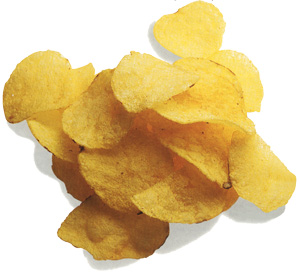
I’m not a huge fan of potato chips. For one thing, I have an MSG allergy. Eating even a tiny amount of synthetic MSG gives me a raging migraine that can last for days, and nearly all brands of potato chips include it. But of the few varieties of chips that I can eat, one of my favorite flavors is salt and vinegar. Oh yes, salty, crispy, tangy. Snap, baby! But do the chip companies actually pour vinegar over the potatoes? No, they add flavoring in the form of sodium acetate.

Now a Jordanian researcher has found a very interesting use for this puckering chemical: concrete sealant!

http://www.physorg.com/news105695773.html

Concrete is very porous and breaks down when water enters all those pours, rusting out the steel innards and, during cold weather, freezing, expanding, and cracking the concrete.

Awni Al-Otoom of the Jordan University of Science and Technology coated concrete with sodium acetate. Sodium acetate, normally a crystal, swells when contacting water. Thus when he applied the water, the sodium acetate at once absorbs the water and blocks further entry of those water molecules into the concrete through that pore. Ingenious. When it dries, the crystal dries too, opening the pore and allowing water that got through to evaporate out. The study is detailed in the Aug. 1 issue of the journal Industrial & Engineering Chemistry Research.

This is, of course, of particular timely interest given the dramatic destruction of the bridge in Minneapolis. Was concrete fatigue at fault? Probably not given it was a mostly-steel bridge, but who can say for sure at this time, since there were concrete portions?

So, in the future, you may be able to cross bridges knowing that the flavor of your chips is protecting your ass as you cross.

I wonder if, as you are crossing, you stop and lick the concrete, would it taste like your salt-and-vinegar chips?


Image taken from HERE.

Tuesday, May 15, 2007

The Dishmaker

Don’t you love eating off of cheap plastic dishes? Well who doesn’t? Look in those cluttered kitchen cabinets of yours. Why, they’re crammed with quality plates, bowls, and cups? Throw them out! Now you can make your own dishes, custom-made for your meal, with the amazing new Dishmaker:

Video: http://www.youtube.com/watch?v=kuGvPhglGEc

Yes, through the miracle of pressed-form engineering, you, too, can be part of the dining future imagined by the Jetsons. Once you’ve installed your Dishmaker, a dishwasher-sized appliance that any of us could find room for on our kitchen counters, simply place a plastic disk into the Dishmaker and program in the form you would like. With a little heat and pressure, that wafer-thin red disk turns into the bowl of your dreams, ready to eat off of in just a minute! Presto chango! That was easy!

When you’re finished eating, simply clean off the bowl and return it to the Dishmaker. With the press of a button, that bowl is re-heated and quickly forms back into a disk to be re-used up to a hundred times! What simplicity! It’s a recycler’s dream! Recyclable paper and re-usable glass dishes are for wimps, and far less cool!

But wait, there’s more! Call in the next 10 minutes and receive the Heatsink, another invention by inventor Leonardo Bonanni:
Video: http://www.youtube.com/watch?v=ki9FL2T9hew

The Heatsink screws on to the end of your kitchen faucet. Turn on the cold water and, voila, it glows an icy blue. When the water gets hot, it glows a fiery red. No more need for exerting yourself to put a hand under the water to gauge the temperature. Ow! It burns! It burns! Avoid the pain and simply watch the heatsink.

That’s right, receive your very own Dishmaker with 15 red disks, enough to set a table with cheap, acrylic dishware, and your additional Heatsink, to make a fluorescent party out of running water. Amaze your friends! Be the envy of every chef and caterer for miles around! Call now!

Thursday, February 15, 2007

African-American Scientists: Shirley Ann Jackson

Continuing my celebration of Black History Month, this week's featured African-American scientist is Shirley Ann Jackson, a theoretical physicist, world expert in nuclear regulation, and current president of Rensselaer Polytechnic Institute.

A good profile: http://www.rpi.edu/president/profile.html

Dr. Jackson is the first African-American woman to receive a doctorate from M.I.T. — in any subject. She is one of the first two African-American women to receive a doctorate in physics in the U.S. She is the first African-American to become a Commissioner of the U.S. Nuclear Regulatory Commission. She is both the first woman and the first African-American to serve as the chairman of the U.S. Nuclear Regulatory Commission, and now the first African-American woman to lead a national research university. She also is the first African-American woman elected to the National Academy of Engineering.

Shirley Jackson was born in Washington, D.C., in 1946. Strongly supported by her parents, she excelled in school, attending accelerated classes in math and science, and graduating in 1964 as valedictorian. She immediately entered M.I.T., studying theoretical physics while volunteering at the Boston City Hospital and the YMCA. Four years later she graduated with her bachelors degree, writing her dissertation on solid-state physics (which was at the forefront of theoretical physics at the time). Although accepted at Brown, Harvard, and the University of Chicago, Jackson decided to stay at MIT for her doctoral work, because she wanted to encourage more African American students to attend the institution. She earned her Ph.D. in elemental particle theory in1973.

In the '70s, Jackson focused on high-energy particle physics, including work at the Fermi National Accelerator Laboratory. In the '80s and early '90s she worked on a wide array of physics including energy superlattices, superconductors, neutrino research, quantum physics, and opto-electronic materials, preparing or collaborating on over 100 scientific articles.

From 1991 to 1995, Dr. Jackson was professor of physics at Rutgers University, where she taught undergraduate and graduate students, conducted research on the electronic and optical properties of two-dimensional systems, and supervised Ph.D. candidates. She concurrently served as a consultant in semiconductor theory to AT&T Bell Laboratories

By the mid-'90s Jackson increasingly became affiliated with politics and nuclear policy. In 1995 President Bill Clinton appointed Dr. Jackson to serve as Chairperson of the U.S. Nuclear Regulatory Commission (NRC), continuing until 1999. As Chairperson, she was the principal executive officer of and the official spokesperson for the NRC. While in this role, Jackson worked with a number of world organizations and served as a liaison between our nation and others for nuclear issues, including the International Atomic Energy Agency. Jackson served 10 years as a member of the New Jersey Commission on Science and Technology, appointed by the governor.

Jackson holds an amazing 40 honorary doctoral degrees, including at Harvard University, and holds more awards than I could reasonably list here. She was inducted into the National Women’s Hall of Fame in 1998 for her significant and profound contributions as a distinguished scientist and advocate for education, science, and public policy. She was inducted into the Women in Technology International Foundation Hall of Fame (WITI) in June 2000. WITI recognizes women technologists and scientists whose achievements are exceptional.

Since 1999, Shirley Jackson has served as the 18th president of Rensselaer Polytechnic Institute, in Troy, New York. Dr. Jackson is married to Dr. Morris A. Washington, also a physicist. They have one son, Alan, a graduate of Dartmouth College.

Thursday, February 8, 2007

African-American Scientists: Guion S. Bluford, Jr.

Given the recent news of out-of-control astronauts, let's take a moment to revisit the heroic and accomplished record of the others. For instance, today, astronaut Michael Lopez-Alegria broke the U.S. record for most time performing space walks as he performed some maintenance work on the International Space Station (CNN Story).

In continuing honor of Black History Month, this Thursday's tribute is for another astronaut of great accomplishment: Guion S. Bluford, Jr., known as "Guy". Bluford, who is now age 65, is an aerospace engineer, a retired colonel in the U.S. Air Force, retired astronaut with NASA's space shuttle program, and the first African-American to go into space.

His Wikipedia biography (which has a link to his NASA bio): http://en.wikipedia.org/wiki/Guion_S._Bluford

Guy was born in Philadelphia, PA, in 1942. I wonder about his first name, Guion. It leaves me scratching my head about the exact pronunciation, but I have to say it rates pretty high on my name-ranking system. Given his nickname is "Guy" I would conclude it is pronounced "guy-on." I couldn't find any information about his youth, except that he was an Eagle Scout with the Boy Scouts of America. Bluford received his BS in aerospace engineering from Penn State in 1964, then attended pilot training, earning his wings in 1966. He was promptly shipped off to Vietnam where he flew 144 missions, 65 of which were over North Vietnam, in less than two years. He soon returned to the U.S. where he became a flight trainer and executive.

Always busy achieving, Bluford found time to earn an MS in aerospace engineering from the Air Force Institute of Technology in 1974, then his PhD in aerospace engineering with a minor in laser physics from the Air Force Institute of Technology in 1978. Apparently his scientific research in his pre-astronaut years revolved around computational fluid dynamics regarding air flow around wing designs for planes and missiles and missle thrust vectoring. He has published at least three papers on these topics, but most of his work was for the military and not shared with the academic world.

Within a year of earning his Ph.D., Bluford became an astronaut with NASA (though he wasn't the first African-American accepted as an astronaut, that honor goes to Maj. Robert Lawrence, Jr., who died in a plane crash prior to going into space). Bluford became the first African-American in space onboard the Challenger in 1983 (the first mission to launch and land at night). He served on three additional space shuttle flights between then and 1992. He was a specialist operating the robotic arm (remote manipulator system), worked with avionics systems, was a key figure on Spacelab experiments, and dealt with payload safety issues. He has logged 688 hours in space. He was inducted into the International Space Hall of Fame in 1997.

Of interesting note is Bluford's association with the Challenger Flag, a U.S. Capitol flag that was given to a Boy Scout troop, then flown on the last Challenger mission. After the flag was recovered (undamaged!) from the remains of the Challenger, Bluford (being an Eagle Scout and astronaut) was the emissary who returned the Challenger flag to Boy Scout Troop 514 of Monument, Colorado in December, 1986. On December 18 of that year, he presented the flag to the troop in a special ceremony at Falcon Air Force Base. The flag has since been honored at a number of ceremonies, including the Winter Olympics at Salt Lake City.

Bluford left NASA in 1993 to take a position as Vice President/General Manager of the Engineering Services Division of a company called NYMA inc., in Brook Park, Ohio. I couldn't find a home page for the company, but they do some sort of engineering contracts for the Department of Defense.

On his NASA page, Bluford's hobbies are listed as reading, swimming, jogging, racquetball, handball, and scuba, but in his own words, during his astronaut years: "The job is so fantastic, you don’t need a hobby. The hobby is going to work."