Thursday, June 28, 2007

Biofuel Isn't Golden Yet

If you’re like me, you get a curious little quiver of excitement when you think about biofuels. Stick it to the oil companies, damn it! Those greedy, all-time record profit conglomerates that suck crude out of the ground in oh-so-unstable parts of the world, helping BushCo wage greedy little wars so they can pump up the costs and make us pay a significant portion of our take-home-pay at the filling station. Yes, the souls of the oil executives run as dark as their product.

Ah, but now we have biofuels. Just take that grease from evil obesity-causing fast food chains and refine it to burn in your VW bus and go happily along down the road smelling like French fries. What could be better? No crude oil went into that engine, thank you!

But there isn’t enough used canola cooking oil to fuel every car, nor do most people care to convert their garage into a refining station. Thus enters the biofuels market.

Now biofuels outlets are popping up all over the place. BioWillie, for instance.

And thus we enter into a glorious future where new and altruistic start-ups fuel our cars with biofuel, crude oil looses its grip on the car fuel market, the world gets less greenhouse gases, there is less and less smog to breathe into our asthma-riddled bodies, and we all live in a happy, hippie, utopia as golden as the canola we feed to our cars.

But wait. It’s never that simple.

Originally, biofuels came from corn. However, even though corn farmers have grown more maize in the U.S. than ever before, they are facing a deficit in the amount that goes to human and livestock food. Too much is going to biofuel, and growing every day, putting our dinner plates at risk for too little deep fried goodies. What are we to do? (HERE is an article discussing the tradeoff).

Okay, so if we can’t get biofuel from corn, we can look for other alternatives. No problem. Corn only yields 18 gallons per acre of refined biodiesel. It’s at the bottom of the list of alternatives, even though it is currently the easiest to grow.

The most promising source for biofuel oils is algae. I’ve blogged on this before. Early research suggests you can get an amazing 10,000 gallons of biofuel per acre of algae, presumably grown in massive vats in the deserts of the world. Unfortunately, research on this lucrative area has only just begun, so we must turn to other options in the meanwhile.

Well, how about trees? Wood pulp contains oils which are now able to be processed out, according to THIS article. But this, too, is a very early technology, far from release. And we wouldn’t want to cut down even more forests, would we? Being good flaming liberals, like me, you would rather forests go to spotted owls.

Well, there are many other alternative crops with large oil content, such as rice, soybean, olives, avocado, or opium poppy. But these face the same old problems of interfering with food sources, being unable to be grown in large enough quantities, or, in the case of poppy, are simply illegal.

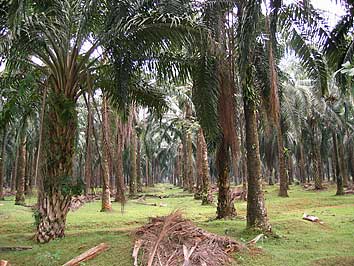
That leaves oil palm. At 625 gallons of refined biofuel per acre, it’s near the top of the list of potential biofuel sources. These lovely palm trees produce fruit very rich in oil. So much, in fact, that it is the second-most produced cooking oil in the world, behind soybean oil. Grow ‘em up in orchards and harvest the fruit, and you’re in the biofuel business. Malaysia, for instance, is a leading nation in converting its cars to biofuel, growing orchards of oil palm, and creating biofuel refineries.

Ah, but here’s that evil little catch: where do you grow them? Why, you have to cut down wide swaths of old growth hardwood forests, or grow over precious crop or grazing land, or fill in delicate marshy ecosystems.

And here’s one I’ll bet you didn’t expect: drug lords. Yes, according to a recent article from TruthOut.com, drug lords in Columbia are KILLING peasants and forcing them off their land to take possession and build oil palm orchards:

http://www.truthout.org/issues_06/060607ED.shtml

It seems growing “legitimate” crops is more lucrative than cocaine, since the Columbian army and the United States (the third most funded military effort behind Iraq and Afghanistan) have attempted to eradicate illegal coca farming and cocaine production. Well, that hasn’t actually worked, since coca production is up 27% since 1999, but never mind. Columbia produces 1.2 million liters of palm oil biofuel a day. It’s not just the rebels and drug lords stealing land, but now even the paramilitary groups formed to fight them have taken land, as well. The Columbian government can’t keep up with the thousands of complaints they get each month.
When you go to the pump to fill up your Volvo with biofuel, there is simply no good way to tell where that fuel comes from.

And let us not forget that ANY source of fuel will eventually lead to greed and price increases.

So what is a good liberal to do, short of selling the car for scrap and biking everywhere? I guess we have to choose the least of the evils: continuing to support greedy global oil conglomerates and their smog- and greenhouse-producing war-causing goo, taking corn- or soy-based food out of the mouths of starving people, gobbling up precious natural lands and supporting drug lords and paramilitary groups with oil palm groves, or simply hoofing it until algae biofuel is made?

You be the judge. For now, I guess I’ll keep supporting big oil.

Now, if you’ll excuse me, I’m going home to eat some deep fried meat bits dripping with canola oil, and I’m not going to refine it to fuel my car, either. So there.


Images modified from HERE, HERE and HERE.

Wednesday, June 27, 2007

iPhone Hysteria

I admit, I’ve become caught up in the iPhone hysteria.

What? You don’t know what an iPhone is? Shame on you for not staying on top of the tech world! Haven’t you seen the amazing commercials? Heard the hype? Why, it’s the most scrumptious piece of technology since the personal computer.

The iPhone is only the most delectable, orgasmic techno toy that geeks like me could possibly ever dream about! It’s a beauty of engineering, slim, sleek, with a flat face about the size of a playing card and no buttons. The flat screen is a touchscreen capable of registering finger swipes and presses, so all the buttons are digital. It goes on sale in two days (June 29), available only from Apple Computer and AT&T outlets.

This marvelous beauty is a cell phone, digital camera, iPod, mobile internet player, streaming video and movie player, digital photo album, and PDA all wrapped up in one. Throw away all those other devices!

Here is Apple’s webpage for their new iPhone: http://www.apple.com/iphone/

I beg you to visit. If you haven’t already seen them, you’ll be blown away by the videos of the iPhone in use.

Ah, but what’s the catch? There’s always a catch, don’t ya know.

The catch is you have to be a frickin’ millionaire to afford the damned thing. The cost of the iPhone is expected to be between $500 and $650(US dollars) depending on memory size, though there may be some initial discounts. AT&T is the exclusive carrier for all internet and phone service, with a $36 activation fee. No other carriers are allowed. They offer three different choices for monthly fees, which differ according to number of minutes and text messages. The cheapest is $60 a month. So, all told, you’re looking at a one-time cost of at least $536 plus at least $720 a year in monthly fees. Ouch. But this is an all-inclusive fee that includes mobile internet, phone, text messages, and (I think) iTunes subscription, so if you don’t already have these things, maybe it’s a little more acceptable.

Report on monthly charges: http://video.physorg.com/?channel=Science+Tech&clipid=885481

Is it worth it? Hmm, lets see. I can either wipe out half a month’s take-home pay for the most anticipated gadget my lustful geeky heart could ever dream of, or I could pay for four months of groceries for my family. Hard choice.

Do I really need a cell phone? I admit there are times I would like one. Do I need mobile internet? No, I’ve got a computer at home and another at work I can use, but on occasion it would be nice. Do I need an iPod? I don’t really listen to music a lot, but maybe if I had this I would. Do I need a video player? No, I have a TV for that, and I barely have time to watch it. Do I need a portable digital photo album. No, my home computer does just fine, but, again, it would be nice to show off my kids’ photos when I’m with friends. Do I need a digital camera? Yeah, I admit, it would be nice from time to time.

So do I really need it? I put it on par with a very good vacuum cleaner. Yes, I said vacuum cleaner. I like to use vacuums as examples – go figure. With vacuums you can make do with some crappy hand-me-down that’s noisy and doesn’t pick up dirt well so you have to go over each strip of carpet several times to clean it, but it gets clean in the end, or you can pay several hundred dollars extra and get some quiet model with lots of accessories and parts that don’t wear out that gets your carpet clean the first time. Is it a luxury you could do without? Sure, but aren’t you glad you made the investment? And you wind up getting a lot of use out of it.

Of course, the iPhone is just the first of a revolution of new combinatorial technology. It won’t be long before every device is like the iPhone. Those of us who are above, oh, 18 years old still see a distinction between computer, stereo, TV, and phone as separate devices. If you ask anyone younger than that about those distinctions, they’ll roll their eyes and text “WTF? That’s like so last century!” to their friends and make fun of you behind your back.

And when they make fun of you, there’s a pretty good chance they’ll use their new iPhone to do it.

So will I buy one? Are you kidding? My wife would kill me for such an egregious waste of money! I'll at least sit back and watch the techno-feeding-frenzy and wait for the bugs to be worked out.

Monday, June 25, 2007

The Case Of The Mysteriously Disappearing Lake

Once upon a time (back in March), there was a beautiful, elfin lake high in the southern Andes of Chile, in the Bernardo O'Higgins National Park. It was a pleasant little lake, with a glacier feeding into it and little icebergs floating along. At only two square hectares, or just under 5 acres, it was small compared to many lakes. Just a wee thing. It drained out into a thin river.

But apparently the lake was pretty far off the beaten path, because two months later, in May, someone finally went back to it and found it was MISSING.

Yes, missing. The entire lake. Gone. Drained away. In place of this 100-foot deep lake was a 100-foot deep crater. The gleeful little icebergs had settled down onto the rocky floor of the lake, bereft of water. Geologists are at a loss to explain what happened:

http://www.cnn.com/2007/TECH/science/06/21/missing.lake.ap/index.html

Quote the article: “’The lake had simply disappeared,’ Juan Jose Romero, head of Chile's National Forest Service in the southernmost region of Magallanes, said Wednesday. ‘No one knows what happened.’” A team of geologists has been dispatched to investigate.

There were no earthquakes to produce rifts for the lake to drain into. There were no alien water-snatchers (I'm guessing). We can’t blame global warming for this one. So what could be the explanation?

One word: incontinence.

Let’s face it, we all have problems. Poor lake, all alone up there, no one to turn to. How embarrassing! It’s been holding its water for, say, about 5 million years. When you gotta go, you gotta go, and that thin little river wasn’t enough of a release. I know how it is. No, I don’t have an incontinence problem, but I’ve been trying to potty train my toddlers for months. Sometimes a diaper is the only way.

There’s no shame in it, little lake.

Friday, June 22, 2007

How To Remove Your Gallbladder

I have a lot of respect for the lowly gallbladder. It’s the unsung hero of digestion. The stomach is such a prima donna, always making such a fuss and getting all the glory. The small intestine, all long and windy, takes up all the room and takes all the credit for final digestion. The large intestine is bloated and slow. And what can I say about the rectum? But the gall bladder is so often overlooked. Why, without this lovely, bulbous, Kermit-the-Frog-green organ, your fatty food simply wouldn’t be digested properly, and the acidity of your intestines would be thrown off. It’s not easy being green. The gallbladder collects and processes bile from your liver, then that bile, mainly bilirubin, goes in and does its job to further digest your food and, let’s not forget, colorize what remains. Sadly, this wonderful little organ has to be removed in some patients when it stops working properly.

If you had to have your gall bladder removed, how do you think they would do it? Most likely they would make a small incision in your belly just to the right of the center of your abdomen. Using laparoscopy (i.e. the use of an endoscope to see inside the body cavity) and remotely-viewed surgical scissors, the surgeons would snip off the gall bladder, remove it through that hole in your belly, and sew you up. You’d be out of the hospital in a day, and would heal over the course of a few weeks. HERE is a YouTube video of a laparoscopic cholecystectomy (gall bladder removal) surgery.

But in the last couple months, a couple surgical teams have taken a very, VERY different approach at gall bladder removal. They believe that going through the body’s natural orifices, one can reduce pain, remove visible scarring, and produce a quicker recovery time. They call the procedure NOTES (natural orifice translumenal endoscopic surgery). Makes sense to me.

But the big question is, WHICH orifice is appropriate?

There are only so many choices.

Two methods come to mind as likely guesses: go through the mouth to the stomach or upper portion of the small intestine, or come up through the anus. I guess the only question you’d have to ask yourself is, “Which of my holes to I respect more?”

A team at Legacy Good Samaritan Hospital and Medical Center in Portland, Oregon, USA, chose the stomach (HERE is an article on it). Going through the patient’s mouth, they cut a hole in the stomach, reached through to do the snipping, pulled the gall bladder back through the hole in the stomach and back up through the mouth, then stitched up the incision. The surgery was a success, but I can only imagine the taste in that poor woman’s mouth afterward.


Patient (upon waking): “Doc, it tastes like I just barfed up my guts.”

Doc: “Yep. Would you like some mouthwash?”


Another team at New York Presbyterian Hospital/Columbia University Medical Center chose a substantially different orifice. No, they didn’t go through the ass. Well, not quite. They went through the patient’s VAGINA! (HERE is an article on it).

I would have liked to have seen the woman's face when the doctor suggested the procedure to her. That couldn't have gone well. The lead surgeon (Marc Bessler) reported his results at the annual meeting of the Society of American Gastrointestinal Endoscopic Surgeons (SAGES) in Las Vegas on Sunday, April 22. The surgery was a success.


Patient (upon waking): “Did everything go all right, Doctor?”

Doc: “Congratulations! You’ve given birth to your gall bladder!”

Patient: “I think I’ll name it Billy Rubin.”


Ah! Now that’s medical progress for ya.


Image taken from HERE.

Thursday, June 21, 2007

Fish Missiles

Watch out, anglers! If you’re fishing in northern Florida, the fish may get their revenge. The endangered armor plated sturgeons there have been jumping out of the water at boats, wounding and nearly killing a number of boaters:

http://www.telegraph.co.uk/news/main.jhtml?xml=/news/2007/06/17/wfish117.xml

These sturgeon fish can get as large as 8 feet long and 200 pounds in weight, and have hardly changed in 225 million years. They are covered in thick, armor-like scales. People on the waterways there have been innocently boating along, thinking pleasant thoughts of murdering hapless little fishies baited with steely hooks cunningly hidden by worms or lures, when suddenly – BOOM! – a gigantic, prehistoric fish leaps out of the water and slams into them, enacting karmic revenge for the slaughter and degutting of its fellow Pisces. According to the article, victims of these fish missiles have suffered a fractured spine, a collapsed lung, ruptured spleen, slit throat, broken ribs, broken jaw, wounds that have required plastic surgery, knocked unconscious, and/or put into a coma!

Geez. Fish & Wildlife doesn’t know why they jump like this, but it is mainly from June to August (“leaping season”). Perhaps, they say, it is simply a way of avoiding the boat, or a form of fish-to-fish communication, or “flushing the gills.” It’s not exactly a typical fish thing. I mean, you never hear anyone say, “What out for that flying trout!” and fishing nets are usually meant to be used in the water.

Personally, I’d like to give the fish some credit for its viciousness. To that end, I’ve concocted a top-ten list for the motivations of these flying sturgeons:

WHAT JUMPING STURGEON ARE THINKING AS THEY PEG BOATERS IN THE HEAD

10. Kill the humans!

9. Gymnastics, fish-style.

8. A sudden craving for man-flesh.

7. I always wanted a boat ride.

6. Cannonball!

5. Who needs wings? Weeeeee!

4. Just trying to get a look around.

3. So you like to eat fish, eh? How’s this for sushi!

2. One small jump for sturgeon, one giant leap for fish-kind.

1. Your worms or your life!


Well, if I ever find myself boating in northern Florida in the summertime, I’ll be sure to wear my chainmail vest and riot helmet, just in case.


My thanks to Scott Adams’ blog entry for a heads-up on this story.

Tuesday, June 19, 2007

Help Wanted: Human Sardines

Imagine yourself surrounded by five of your coworkers in a small house in the mountains. Go on, pick out five of your coworkers, I’ll wait. For the sake of ease, pick the five you like the most. If you aren’t the sort of person who works at a job with lots of people, you can pick out five good acquaintances.

Here’s a hypothetical situation: You meet these people for a dinner party at a mountain chalet. You are socializing, but all of you have also brought your work with you to do later.

Now imagine that an avalanche buries you all in the house such that there is no way out. You are in no mortal danger, and you have all the food, drink, recreation material, and facilities that you need to live for years. Your boss calls and says you all have to keep working normal hours, but it would be more than a year before they can dig you out. Good luck.

Do you think you could do it? Could you get along with all of them in such close, cramped quarters, and get your work done – for more than a year?? Do you really feel so close to your fellow workers that you’d all get along peachy? Or do you think cabin fever would start creeping in?

I don’t know if I could do it. Maybe I wouldn’t mind being around a couple of my coworkers that long, but I’d be more worried about them tolerating me! There’s a very good reason why I’m not writing this blog from a Navy submarine right now.

Now imagine that you aren’t in a closed-in mountain chalet, but in a spaceship headed for Mars, or on Mars itself. Are you shrugging it off right now, or are you thinking like I am that by the fifth month you’d be prying open the airlock and seeing for yourself how many milliseconds it would take for your eyeballs to freeze in the vacuum of space?

The European Space Agency (ESA) is about to test this scenario (no, not the eyeball-freezing part – the long-term habitation part):

http://www.physorg.com/news101457611.html

They put out a call for paid European volunteers in excellent mental and physical health to serve as guinea pigs. These intrepid volunteers will be paid 120 euros a day (= $158US) to live for up to 17 months in a closed habitat the size of about “nine truck containers.” Others will live 105 days in preliminary trials under similar situations. They’ll be doing work-like activities and testing, and will have to face simulated emergency situations, but mainly they’ll have to face long periods of inactivity and potential boredom. There will be six people in each habitat. Their only contact with the outside world will be by radio, with a simulated 40-minute delay, and whatever they are allowed to bring in with them. What will happen, researchers wonder?

According to the article:
“Assuming that Mars and Earth are favourably aligned, with their closest distance of 56 million kilometres (35 million miles), it would take 250 days to get there, 30 days spent on site to conduct experiments and 240 days for the return”

Yay! Astronauts have done this on space stations. You can too, right? You get used to the locker room smell pretty quickly, and packaged rations can seem pretty yummy if you brainwash yourself enough, I imagine. Why, it would be a blast. Just bring along your Pictionary set and you’ve got it made!

If this sounds appealing to you, here’s the link to the application webpage:
http://spaceflight.esa.int/users/index.cfm?act=default.page&level=16&page=2203

Personally, I think I’d rather swallow live leeches. But that’s just me. You go ahead.


Image taken from HERE.

Sunday, June 17, 2007

Father's Day, And Carrying My Children Through The Forest

Happy Father's Day to all you papas, grandpapas, and papas frites out there. We spent Father's Day picnicking at a nearby state park, then hiking a new trail (for us) up in the mountains with the family, enjoying the spirit of discovery I saw in the eyes of my kids as they explored the subtle joys of throwing rocks into a lake, splashing in the mud, and hugging trees along the trail. Though they are only toddlers, my son and daughter are real troopers. Still, by the end of it, I was carrying both of them when they ran out of steam. I didn't mind, though. That's what dads are for, after all.

Of course, I had started down the trail with the intention of making them walk all the way. Inevitably, it was my daughter who first broke me of that idea. How did she do it? Yep, you guessed it. She stood in front of me, arms wide, and looking at me with those adorable please-please-please eyes. How could I possibly say no to someone so cute? Oh, man, the things she's likely to get away with over the years!

I'm not alone in being influenced by my daughter. A study was recently released by researchers in economics and psychiatry from Yale that showed male congressmen who have daughters are more likely to support women's rights and health issues:

http://www.physorg.com/news101125978.html

But is it really surprising? Don't we naturally relate most to issues we have the closest connections to? According to the article: "Kyle Pruett, a clinical professor of psychiatry at Yale University's Child Study Center, said daughters make fathers 'think differently about how they're going to make the world a better place.'"

Yep. I consider myself an advocate for women's rights, anyhow, but I have no doubt she, and my son, will change the way I see the world, and in a big way. I think it's a reasonable argument that, though we play a pivotal role in molding the way our children see the world as they grow up, in the end it is our children who change us more.